Keeping Pace: Why Northern Ireland Must Implement the EU Pay Transparency Directive
March 31, 2026
The Windsor Framework contains a small but important set of protections for human rights standards in Northern Ireland that derive from our previous membership of the European Union. These could be very simply categorised as the ‘non-diminution’ commitment and the ‘keeping pace’ commitment.
The non-diminution commitment arises from Article 2 of the Windsor Framework which commits the UK Government to ensuring that the rights contained within the ‘Rights, Safeguards and Equality of Opportunity’ section of the Belfast/Good Friday Agreement (‘1998 Agreement’) are not diminished. There are a series of very specific tests which must be met to trigger this protection and to date this element has been explored and tested in considerable detail by Northern Ireland courts across a range of judgments (SPUC, Angesom, JR295, Dillon) and we now await the final arbitration by the UK Supreme Court as to the ultimate strength and scope of the non-diminution powers when they rule in the Dillon case in the coming weeks.
By contrast, the ‘keeping pace’ commitment has received far less attention to date, with no litigation testing its scope. This obligation also stems from Article 2 of the Windsor Framework, which requires the UK Government to maintain in Northern Ireland law the application of six EU equality directives listed in Annex 1 of the Framework.
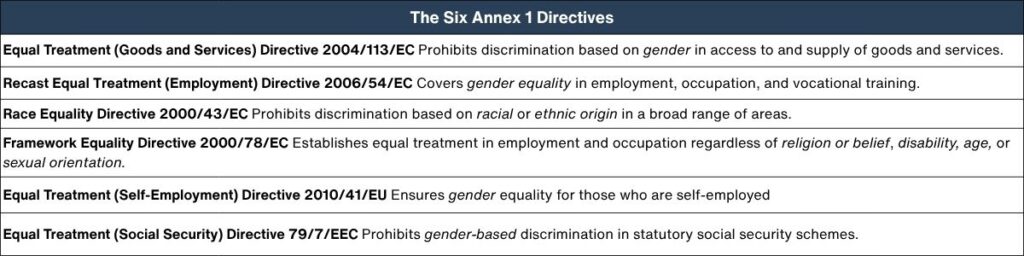
Not only do these six equality Directives continue to apply in Northern Ireland but significantly Article 13(3) of the Framework also stipulates a dynamic alignment obligation, which means that if the Directives are changed or updated at an EU level that Northern Ireland protections must also ‘keep pace’ with those amendments or replacements locally.
Unlike the non-diminution commitment there has not been the same level of focus on how these protections are applied practically – until now.
The EU Pay Transparency Directive (PTD) was introduced in 2023 and aims to strengthen the application of the principle of equal pay for equal work or work of equal value between men and women through enhanced pay transparency and enforcement mechanisms. The Directive must be transposed into law by member states by June 2026.
The Equality Commission for Northern Ireland (ECNI) and the Northern Ireland Human Rights Commission (NIHRC) (the ‘Dedicated Mechanism’) have analysed the PTD and concluded that, apart from a few provisions irrelevant due to the UK’s departure from the EU, the PTD significantly amends and replaces aspects of the Recast Equal Treatment Directive, one of the six equality Directives listed in Annex 1 of the Windsor Framework.
The Recast Equal Treatment Directive introduced in 2006 is a core instrument of gender equality law within the EU. It merged and updated several elements of EU law on equal pay and equal treatment in employment and made sex discrimination unlawful in key areas of employment. It ensures that men and women are treated equally in the workplace, guarantees equal pay, outlaws sex discrimination and harassment, and requires EU countries to provide effective remedies for violations. The Northern Ireland Assembly passed specific legislation to incorporate the protections of the Directive. The Sex Discrimination Order (NI) 1976 (Amendment) Regulations 2016 were passed to ensure that Northern Ireland was compliant with the duties under the Directive.
We share this assessment and given the commitments under the Article 2 and Annex1 believe that the UK Government are under a duty to transpose the PTD into Northern Ireland law. This would represent a significant advancement on current protections as Northern Ireland is the only part of the United Kingdom without any gender pay reporting legislation as provisions in this area contained in the Employment Act (Northern Ireland) 2016 (that fall short of the PTD protections) have never been commenced.
The importance of implementing the Payment Transparency Directive in Northern Ireland
In Northern Ireland, a female employee earns an average of £1.14 less per hour than her male counterpart. This sets the Northern Ireland gender pay gap at an average of 7.3%, which is marginally better than the 11.1% European average but there remains a long way to go towards gender pay equality.
 The Pay Transparency Directive (PTD) seeks to assist in reducing the gender pay gap by enhancing and amending existing gender equality legislation. The Directive introduces several new measures that require employers to report on and provide information about the gender pay gap in their organisations.
These amendments include, but are not limited to:
-
Article 5: Pay transparency prior to employment – this new amendment would require employers to provide the initial pay level on the job vacancy advertisement, and this initial pay level must come from gender-neutral, objective criteria.
-
Article 7: Right to information – Employees have the right to be provided with the information necessary to assess whether they are paid in a discriminatory manner or not.
-
Article 9: Reporting on pay gap – Employers with at least 250 employees must report on the pay gap annually; this reporting must also include the median gender pay gap in complementary or variable components.
-
Article 10: Joint pay assessment – Where a gender pay gap of at least 5% exist and cannot be justified with objective gender-neutral criteria, the employer must conduct a joint pay assessment in co-operation with workers’ representative.
There are also amendments on the enforcement of where gender pay gaps are found and for failure to comply with reporting duties. These include, but are not limited to:
-
Article 23: which strengthens the existing provisions on penalties for employers where a gender pay gap is found.
-
Article 16: which strengthens the provisions for victims of gender-based pay discrimination to receive compensation.
The Consortium’s view is that the PTD must be implemented into Northern Ireland law given the ‘keeping pace’ obligation under Article 2 of the Windsor Framework. The PTD clearly amends the Recast Directive, one of the six equality directives in Annex 1. Therefore, as the EU changes its laws; Northern Ireland must do so too.
However, to date there has been little practical progress on implementing the Pay Transparency Directive in Northern Ireland.

Part of the delay initially stemmed from the fact that the European Commission has no existing structure to assess, at the legislative design phase, whether a new directive falls within the scope of the Article 2 commitments. The current assessment of the PTD’s relationship to the Windsor Framework only began after the Directive was passed by the EU Parliament and raised by civil society and the Dedicated mechanisms.
In addition, the UK Government was initially resistant to the idea that a duty existed to introduce the PTD into Northern Ireland law. In a letter responding to questions from the European Scrutiny Committee (15th July, 2021) on how the proposed PTD interacted with Article 2 of the Windsor Framework, the Minister of State for Northern Ireland argued that whilst the UK Government remains committed to ensuring matters of pay transparency are dealt with, they do not see that there is “any requirement to go further than the requirements to assess this already included in the protocol.”
The response also highlighted that the UK Government would continue to “work to ensure that rights and equality protections in Northern Ireland are broadly the same as the UK”. However, given there is currently no legislation in Northern Ireland requiring gender pay gap reporting, this only emphasises the need for the up-to-date legislation in the PTD to be implemented in Northern Ireland.
Under Section 19 of the Employment Act (NI) 2016 a responsibility was created for the Department for Communities to introduce regulations for employers to produce gender pay gap information. The Department for Communities has never implemented this provision. In a 2025 consultation it sought views on how to take forward these obligations but showed no evidence that it had screened the proposed policy to ensure it was in line with the keeping pace obligations under Article 2 of the Windsor Framework. Had the Department carried out this screening, it would have discovered that the gender pay gap reporting duties established under the PTD exceed the proposals in its consultation and reaffirmed the duty to transpose the EU Pay Transparency Directive into Northern Ireland law.
Since that time the Consortium and several of its members (including WRDA and NIC-ICTU) have been advocating with UK and EU officials involved in the Specialised Committee on the Windsor Framework via the NI UK-EU Civic Working Group for the adoption of the Directive. The EU and UK have now accepted in principle that the PTD needs to be included in Northern Ireland law and work is underway to assess how that can be achieved with local Departments and public authorities.
The need to implement the enhanced protections of the EU Pay Transparency Directive into Northern Ireland law is now both urgent and unavoidable. There is not only a clear legal obligation flowing from Article 2 and Annex 1 of the Windsor Framework, but a vital opportunity to meaningfully advance gender equality in workplaces across Northern Ireland. The Consortium will continue to press for full and timely implementation, ensuring that this crucial element of the Windsor Framework is properly tested, respected, and delivered in a positive and constructive way. If implemented with care, rigour, and vigilance, the Directive has the potential to transform how pay inequality is monitored and addressed, finally providing women in Northern Ireland with the transparency and accountability they have long been denied. The moment for action has arrived and it is essential that government, public bodies, and employers meet it.
This article was written by: Ella Griffiths
Ella Griffiths was the Queen’s University Belfast, School of History, Anthropology, Politics and Philosophy volunteer from January to April and took a leading role in the writing and researching of this article.